
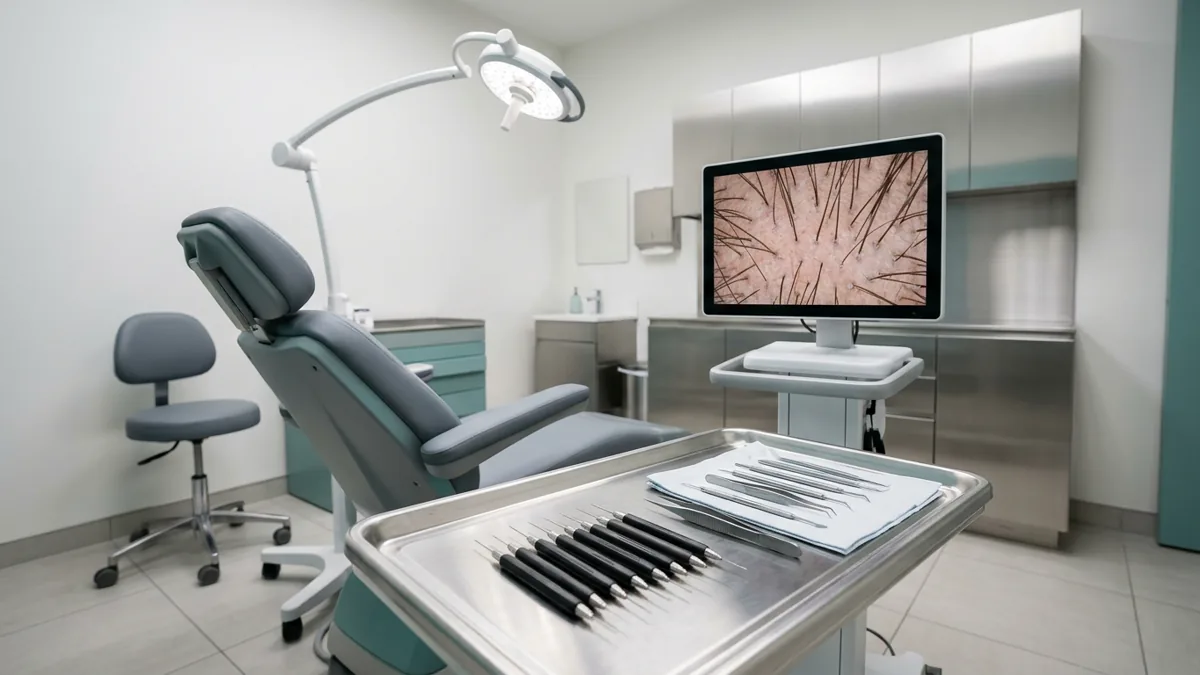
As the International Society of Hair Restoration Surgery (ISHRS) clarifies, DHI is a modified FUE implantation method using Choi implanter pens rather than a wholly separate procedure—both extract individual follicular units via micro-punch and achieve 90%+ graft survival in qualified hands. Technique choice matters far less than whether a licensed physician performs the surgical incisions and protects the finite donor zone from over-harvesting.
Istanbul performs more follicular unit hair restorations for international patients than almost any other medical hub worldwide. However, marketing terms surrounding FUE, Sapphire FUE, and DHI frequently confuse prospective patients into believing one acronym guarantees superior hair density. Understanding how extraction and implantation actually work helps you select a technique based on anatomy—and vet clinics against international surgical safety standards.
1. How FUE and DHI Differ Technically (and What They Share)
In both Follicular Unit Excision (FUE) and Direct Hair Implantation (DHI), the donor extraction phase is fundamentally identical: after local anesthesia, individual 1- to 4-hair follicular units are harvested from the permanent occipital and parietal donor fringe using motorized or manual micro-punches typically 0.7 mm to 0.9 mm in diameter.
The clinical difference lies strictly in the recipient-site implantation step:
- FUE (Channel-First / Sapphire FUE): The surgeon first creates thousands of microscopic recipient channels across thinning or bald skin using micro-blades (steel or V-tipped sapphire blades), controlling exit angle, direction, and spacing before placing grafts gently into the channels with micro-forceps.
- DHI (Choi Implanter Pen): Harvested grafts are loaded straight into hollow, spring-loaded sharp Choi implanter pens (0.6 mm to 1.0 mm) and inserted directly into the scalp without pre-cut recipient slits, simultaneously creating the tract and releasing the follicle.
| Clinical Parameter | Sapphire / Standard FUE | DHI (Choi Implanter Pen) |
|---|---|---|
| Donor Harvesting Method | Micro-punch follicular excision (identical harvesting biology). | Micro-punch follicular excision (identical harvesting biology). |
| Recipient Channel Creation | Pre-made micro-slits using steel or sapphire blades prior to forceps placement. | Single-step direct incision and follicle placement using Choi implanter needles. |
| Best Clinical Fit | Larger balding areas (Norwood IV–VI), broad hairline reconstruction, higher graft counts (>3,000 grafts). | Targeted density packing between existing native hair, unshaven/partially shaven focal areas, eyebrows/beards. |
| Expected Graft Survival (Qualified Hands) | ~90%–95%+ when out-of-body ischemia time, hydration, and trauma are minimized. | ~90%–95%+ when sharp pen loading avoids bulb compression or dermal trauma. |
2. Biological Timeline: Healing, Shock Loss & Regrowth
Whether performed via Sapphire FUE or DHI, transplanted follicles follow the same microvascular biology. Controlled ischemia time and chilled holding solutions (such as HypoThermosol or Ringer’s lactate) preserve cellular viability during the brief interval out of the scalp.
- Days 1 to 3 (Plasma Imbibition): Newly placed follicles depend on passive oxygen and nutrient diffusion from surrounding tissue fluid; mechanical rubbing or head bumps can dislodge grafts permanently during the first 72 hours.
- Days 4 to 7 (Angiogenesis & Scab Resolution): Capillary blood supply reconnects to the dermal papilla, and gentle clinical washes loosen dried fibrin crusts.
- Weeks 2 to 6 (Telogen Effluvium / Shock Loss): Transplanted hair shafts shed naturally as follicles enter a resting telogen phase—an expected physiological step, not graft failure.
- Months 3 to 5 (Early Anagen Emergence): Fine initial hairs begin breaking through the epidermis, often unevenly at first.
- Months 9 to 14 (Maturation & Caliber Gain): Hair shafts thicken in diameter and curl/angle blend naturally into surrounding native hair for final aesthetic assessment.
3. Physician Accountability vs. Unlicensed “Technician Clinics”
The International Society of Hair Restoration Surgery (ISHRS) explicitly classifies donor-punch excision, recipient site creation, and sharp Choi implanter insertion as surgical medical acts that penetrate human skin. Global patient safety advisories—supported by Turkish Ministry of Health regulations—warn against high-volume “black market” clinics where one nominal doctor lends a name on paper while non-medical technicians run unsupervised extraction and channel opening across multiple rooms simultaneously.
Over-harvesting the donor area with overly large punches or taking 4,500+ grafts in a single uncontrolled session can permanently leave patchy moth-eaten scars at the back of the head and exhaust reserve follicles needed if native hair continues thinning later in life. Ask specifically who designs the hairline, who extracts grafts, and who makes every recipient incision, and cross-check institutional licensing via our Turkey medical tourism safety guide and clinical timeline principles.
4. Practical Checklist Before Booking Hair Restoration in Turkey
- Confirm the clinic holds an active Ministry of Health Health Tourism Authorization Certificate and operates inside a licensed medical center or hospital.
- Verify single-patient-per-surgeon attention or explicit physician involvement in surgical excisions and channel/implanter steps.
- Ensure trichoscopy measurement of donor density (follicular units/cm²) and miniaturization ratio precedes any graft-count promise.
- Discuss long-term medical stabilization of non-transplanted native hair (such as topical minoxidil or finasteride suitability with a physician) to prevent isolated hairlines as natural loss progresses.
Frequently Asked Questions
Does DHI always yield higher graft survival than Sapphire FUE?
No. Clinical comparisons show comparable ~90%–95%+ survival rates for both methods when performed properly. Survival drops in either method if grafts dry out, stay out of the body too long, or suffer forceps/implanter crush injury—making surgical team skill far more decisive than the tool name.
How long must I stay in Turkey after an FUE or DHI transplant?
Most patients stay 3 to 4 days total: Day 1 pre-op bloodwork and consultation, Day 2 procedure, Day 3–4 first gentle clinic wash and post-op inspection before flying home.
Is a hair transplant completely scarless?
No surgical incision is truly 100% scarless. Micro-punches leave tiny dot micro-scars (<1 mm) across the donor zone that remain virtually invisible at normal hair lengths when harvesting stays evenly distributed within safe donor limits.
When can I exercise or swim after surgery?
Light walking can resume after several days, while heavy lifting, sweating, swimming pools, saunas, and direct sun exposure are normally restricted for 2 to 4 weeks to protect scalp vascular healing.