
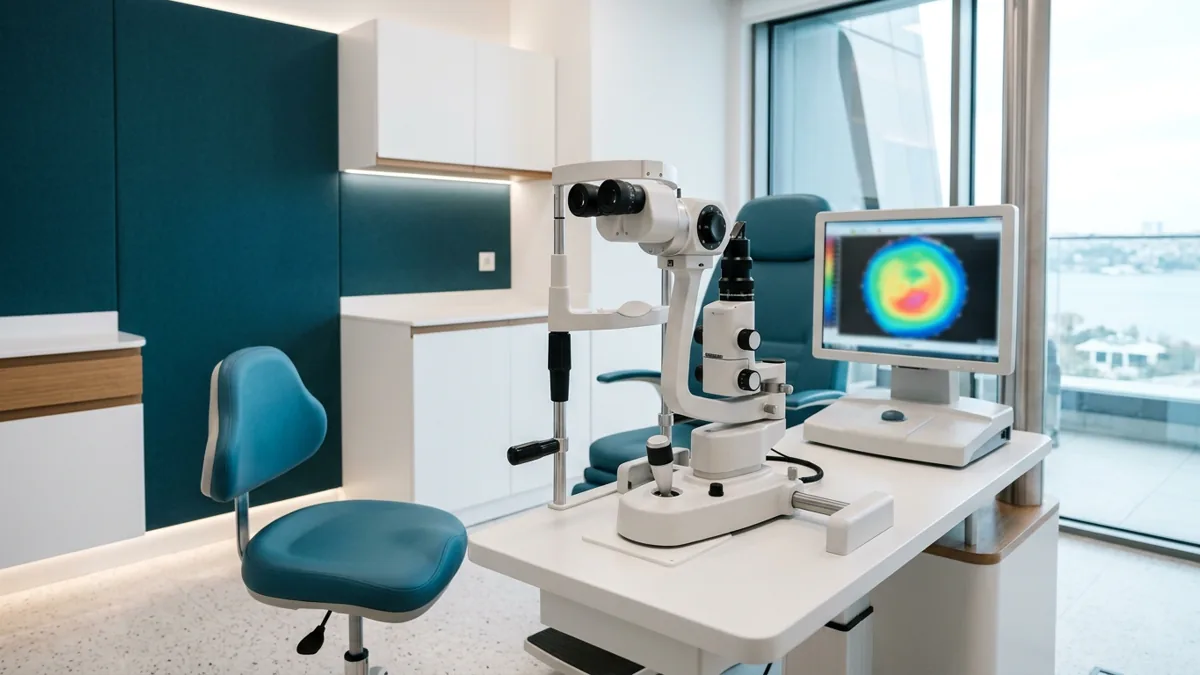
Choosing between SMILE, Femto-LASIK, PRK, or Cataract/Presbyopia IOL surgery in Turkey hinges strictly on preoperative corneal pachymetry, corneal topography, and residual stromal bed (RSB) safety limits. Both AAO and ESCRS protocols enforce an absolute minimum RSB floor of 250 μm (targeting ≥300 μm clinically) alongside a Percentage of Tissue Altered (PTA) threshold below 40% to prevent post-operative corneal ectasia.
Eye hospitals across Istanbul and Ankara attract international patients seeking freedom from corrective lenses or accelerated cataract extraction without multi-month waiting lists. While laser platforms such as Carl Zeiss VisuMax (SMILE) and modern excimer tracking lasers deliver sub-millisecond ablation speed, long-term visual stability depends on strict diagnostic disqualification of borderline corneas—not promotional pricing.
1. Comparing SMILE, Femto-LASIK, PRK & Lens Surgery
Rather than treating laser vision correction as a single uniform package, ophthalmologists select from three primary corneal approaches plus intraocular lens (IOL) replacement based on refractive error, central corneal thickness, and tear-film baseline.
| Procedure | Mechanism & Flap Status | Primary Advantages | Minimum Safety & Recovery Notes |
|---|---|---|---|
| PRK / Surface Ablation | No corneal flap; epithelium gently removed before excimer sculpting. | Preserves maximal stromal thickness; preferred for borderline thin corneas or contact-sport patients. | Surface epithelial healing takes 3–5 days with mild discomfort; final clarity refines over 4–8 weeks. |
| Femto-LASIK | Creates 100–110 μm femtosecond hinged flap before stromal ablation. | Fast visual recovery within 24–48 hours; corrects myopia, hyperopia, and astigmatism broadly. | Requires greater starting corneal thickness; must keep RSB ≥250–300 μm and PTA <40%. |
| SMILE (Small-Incision Lenticule Extraction) | Flapless femtosecond lenticule extraction via tiny 2–4 mm peripheral incision. | Preserves anterior stromal collagen lamellae and corneal nerves better, lowering severe dry-eye incidence. | Typically advised when corneal thickness is ≥475 μm+; fast visual return over days to 2 weeks. |
| Cataract / Trifocal & EDOF IOL | Phacoemulsification replaces aging crystalline lens with acrylic IOL. | Eliminates cataract clouding and presbyopic reading dependence simultaneously. | Requires macular OCT retinal screening first; bilateral eyes often staggered 24–72 hours apart. |
2. Biomechanical Safety Thresholds: RSB ≥250–300 μm and PTA <40%
The single most serious avoidable complication of excessive keratorefractive ablation is iatrogenic corneal ectasia—a progressive forward bulging of thinned corneal stroma that distorts vision permanently. International guidance from the American Academy of Ophthalmology (AAO) and ESCRS highlights two quantitative safeguards every patient should ask to see on their Pentacam tomography printout:
- Residual Stromal Bed (RSB): Leaving less than 250 μm of untouched posterior stroma (excluding flap or cap thickness) violates standard international safety margins; conservative surgical plans aim for ≥300 μm.
- Percentage of Tissue Altered (PTA): Calculated as
(Flap Thickness + Ablation Depth) / Central Corneal Thickness. Even when RSB exceeds 250 μm, a PTA ≥40% acts as an independent warning flag for post-LASIK ectasia.
3. Essential Records for Future Cataract & IOL Surgery
Corneal laser sculpting modifies the anterior-to-posterior curvature ratio of the cornea. Decades later, when normal age-related cataracts develop, standard cataract IOL power formulas can underestimate corneal flattening and trigger refractive surprises unless historical values exist or specialized calculation tools (such as Barrett True-K) are applied.
Before flying home from Turkey, collect a printed and digital copy of your **pre-operative keratometry (K1/K2), Pentacam corneal map, preoperative refraction, and exact optical ablation profile**. Pair these records with the discharge practices outlined in our Turkey medical tourism safety guide and check fit-to-fly medical guidelines.
4. Recommended Clinic Stay & Post-Op Slit-Lamp Checks
Plan at least 4 to 5 days in Turkey for refractive surgery or bilateral staggered lens replacement. Day 1 encompasses dilated fundoscopy, endothelial cell counts, corneal topography, and dry-eye osmolarity testing; Day 2 is surgery; Day 3 and Day 4 provide 24-hour and 72-hour slit-lamp inspections confirming epithelial integrity, clean interface alignment, and normal intraocular pressure prior to cabin pressure exposure.
Frequently Asked Questions
Who is disqualified from LASIK or SMILE even if they wear glasses?
Patients with keratoconus, subclinical forme-fruste topography asymmetry, unstable refractive prescription changing >0.50 D in 12 months, insufficient stromal thickness, uncontrolled glaucoma, or severe autoimmune dry eye should avoid corneal laser ablation and explore Phakic ICL or non-surgical optics.
How soon can I fly after SMILE, LASIK, or cataract IOL surgery?
Uncomplicated SMILE, LASIK, and standard cataract IOL patients are typically cleared to fly 48–72 hours after slit-lamp confirmation using preservative-free artificial tears in dry airplane cabins. Avoid rubbing eyes rigorously during weeks 1–2.
Should both eyes receive cataract lens replacement on the exact same day?
Many surgeons stagger bilateral lens implants by 24 to 72 hours (sequential rather than simultaneous) so day-1 refractive response and sterility of the first eye can be verified before operating on the second.
Can mild vision regression years later be corrected safely?
Yes—provided residual corneal thickness remains adequate, surface PRK combined with Mitomycin-C (MMC) is commonly preferred over lifting old LASIK flaps to avoid epithelial ingrowth.