
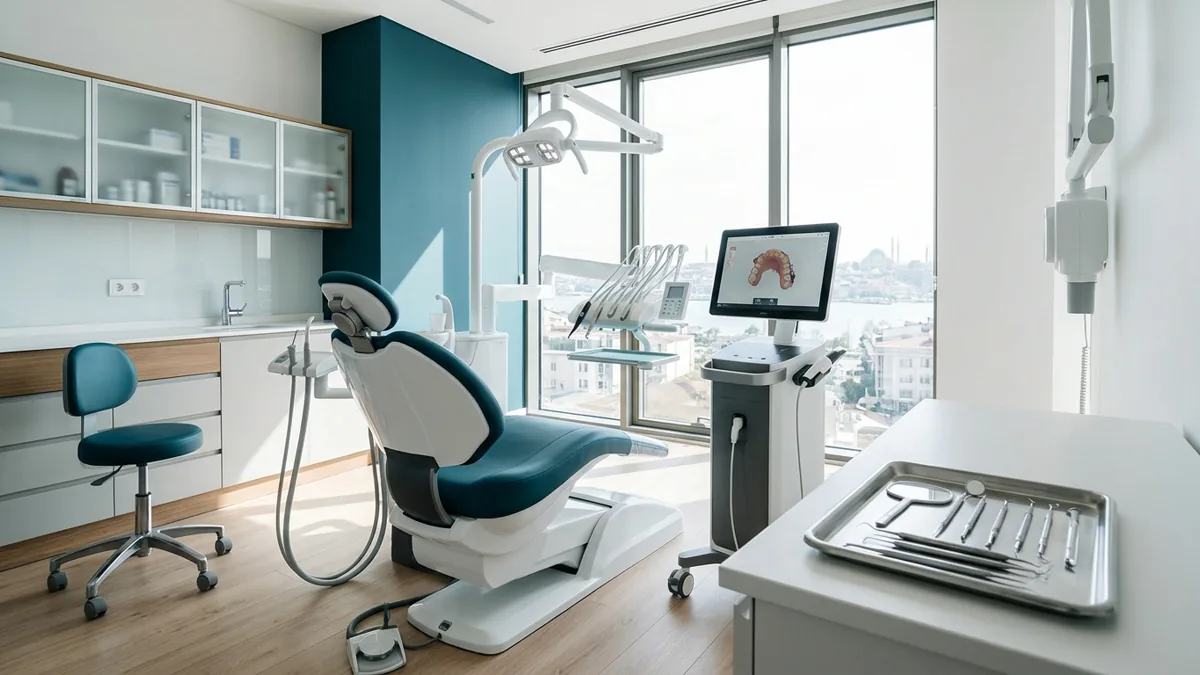
Peer-reviewed systematic reviews report 95% to 98.4% short-to-medium-term dental implant survival and 93% to 96% survival at 10 years when placed with proper primary stability and bone volume. In conventional two-stage protocols, unloaded osseointegration takes 3 to 6 months—meaning safe full-crown restoration in Turkey usually requires two separate visits rather than one rushed week.
International dental travel to Istanbul, Antalya, and Izmir has grown rapidly because private dental hospitals combine 3D cone-beam CT (CBCT) diagnostics, CAD/CAM milling, and internationally distributed titanium or zirconia implant systems. Yet the clinical success of a dental implant depends primarily on biology, sterile surgical planning, and occlusion mechanics—not travel package speed.
1. Why Osseointegration Dictates Your Treatment Timeline
A titanium or zirconia root-form implant succeeds through osseointegration: the direct structural and functional connection between living alveolar bone and the load-bearing implant surface. Clinical implantology literature demonstrates that conventional unloaded healing protocols generally require 3 to 4 months in the denser lower jaw (mandible) and 4 to 6 months in the softer upper jaw (maxilla), extending longer when sinus augmentation or block bone grafting is performed.
Patients considering traveling from abroad should separate marketing phrases like “teeth in five days” from actual clinical protocols. While an experienced prosthodontist can deliver a screw-retained acrylic provisional (temporary) bridge within 48–72 hours under strict immediate-loading conditions—provided insertion torque reaches sufficient primary stability (typically ≥35 Ncm) across splinted fixtures—placing heavy definitive monolithic zirconia crowns over unhealed single implants or grafted bone substantially increases early crestal bone loss and biomechanical overload.
| Protocol Stage | Clinical Activity | Typical Healing Window |
|---|---|---|
| Phase 1: Diagnostics & Placement (Visit 1) | 3D CBCT bone-volume mapping, atraumatic extractions, guided titanium/zirconia fixture placement, optional bone graft/sinus lift, and temporary prosthesis. | 5–7 days in clinic for placement and suture check. |
| Biological Osseointegration (Home Recovery) | Remodeling of woven bone into lamellar bone around implant micro-threads while avoiding excessive chewing force. | 3–4 months (mandible); 5–6+ months (maxilla or sinus/bone graft). |
| Phase 2: Definitive Prosthesis (Visit 2) | Torque-test stability check (ISQ), custom abutment scanning, occlusal bite calibration, and seating final porcelain-fused-zirconia or lithium disilicate restorations. | 5–7 days in clinic for lab try-ins and final delivery. |
2. Evidence-Based Implant Survival Rates and Risk Variables
Longitudinal clinical meta-analyses published on PubMed show high predictability: early failures occurring prior to prosthetic loading average roughly 1%–2%, 5-year cumulative implant survival commonly sits between 95% and 98.4%, 10-year survival ranges around 93%–96%, and 20-year cohort studies continue to report survival near 93% under regular periodontal maintenance.
Outcomes vary meaningfully by individual patient physiology and clinic hygiene rather than geography:
- Smoking & Nicotine: Heavy smoking impairs microvascular blood flow to healing soft tissue and bone, roughly doubling peri-implantitis and early failure risk compared with non-smokers.
- Glycemic Control: Poorly controlled diabetes (elevated HbA1c) slows wound healing and heightens bacterial infection risk; stable glycemic management restores outcomes closer to baseline.
- Active Periodontitis & Bruxism: Gum infections must be fully stabilized prior to surgery, and nighttime tooth grinding (bruxism) requires protective occlusal splints after crown delivery.
- Implant Surface & Component Compatibility: Choosing globally stocked implant systems (Straumann, Nobel Biocare, Astra Tech, BioHorizons, Osstem, or documented CE/FDA-cleared equivalents) ensures prosthetic screws and driver kits remain serviceable by a local dentist years later.
3. Crowns vs. Veneers: Preventing Over-Preparation of Healthy Teeth
A critical safety concern flagged by international dental associations involves clinics recommending full-coverage 360-degree zirconia crowns on healthy young natural teeth purely to achieve uniform bright aesthetics in five days. Aggressive enamel and dentin reduction can compromise dental pulp vitality—causing irreversible nerve sensitivity or requiring multiple root canals months later—whereas thin porcelain veneers or orthodontic alignment + bleaching preserve tooth structure. Always ask for minimally invasive options and clear diagnostic radiographs justifying every crown.
4. Verifying Credentials Before Dental Travel to Turkey
As detailed in our complete Turkey medical tourism patient guide, confirm that your dental polyclinic or hospital holds a current Ministry of Health Health Tourism Authorization Certificate and uses 3D CBCT imaging rather than flat 2D panoramic films alone. Obtain itemized treatment plans separating surgical fixtures, grafting biomaterials, temporary teeth, and final prosthetics, and insist on keeping original implant lot labels and CBCT DICOM files upon discharge. Comparing procedural hygiene and recovery expectations across specialties—such as our FUE vs. DHI clinical guide—helps align total travel recovery budgets safely.
Frequently Asked Questions
How long do I need to stay in Turkey for dental implants?
Plan 5 to 7 days for the initial surgical placement visit, followed by 3 to 6 months of healing at home, and another 5 to 7 days for final abutments and crowns during Visit 2. Immediate final crowns on newly grafted sites are rarely clinically advisable.
What documentation should I bring home from my Turkish dental clinic?
Request an English surgical report, pre- and post-op CBCT/X-ray imaging on USB or cloud link, the exact brand, diameter, length, and UDI/lot stickers of every implant and abutment, plus torque/material specifications for any fixed bridge.
Are dental implants in Turkey safe for patients with diabetes or bone loss?
Often yes, provided systemic health is medically optimized first. Well-controlled diabetic patients heal reliably, and localized jawbone loss can frequently be reconstructed using guided bone regeneration (GBR) or sinus floor elevation prior to—or simultaneous with—implant placement.
Can my local dentist maintain implants placed in Turkey?
Yes, provided the clinic uses traceable, internationally distributed implant brands whose prosthetic screwdrivers, scan bodies, and replacement abutments are readily accessible in your home country.